Saturday, August 24, 2013

Thursday, April 25, 2013
Süleymaniye Mosque

The Süleymaniye Mosque is an Ottoman imperial mosque located on the Third Hill of Istanbul. It is the largest mosque in the city, and one of the best-known sights of Istanbul.
The Süleymaniye Mosque, built on the order of Sultan Süleyman (Süleyman the Magnificent), "was fortunate to be able to draw on the talents of the architectural genius of Mimar Sinan" (481 Traditions and Encounters: Brief Global History). The construction work began in 1550 and the mosque was finished in 1558.
The Süleymaniye Mosque, built on the order of Sultan Süleyman (Süleyman the Magnificent), "was fortunate to be able to draw on the talents of the architectural genius of Mimar Sinan" (481 Traditions and Encounters: Brief Global History). The construction work began in 1550 and the mosque was finished in 1558.
Entrance: Free of charge
Coordinates: 41°0'58.16"N 28°57'50.03"E
Basilica Cistern

The Basilica Cistern is the largest of several hundred ancient cisterns that lie beneath the city of Istanbul. was built in the 6th century during the reign of Byzantine Emperor Justinian I.
This cathedral-size cistern is an underground chamber approximately 9,800 square metres (105,000 sq ft) in area, capable of holding 80,000 cubic metres (2,800,000 cu ft) of water. The ceiling is supported by a forest of 336 marble columns, each 9 metres (30 ft) high, arranged in 12 rows of 28 columns each spaced 4.9 metres (16 ft) apart.
Fifty-two stone steps descend into the entrance of the cistern. The cistern is surrounded by a firebrick wall with a thickness of 4 metres (13 ft) and coated with a waterproofing mortar. The Basilica Cistern's water came from the Eğrikapı Water Distribution Center in the Belgrade Forest, which lie 19 kilometres (12 mi) north of the city. It traveled through the 971 metres (3,186 ft)-long Valens (Bozdoğan) Aqueduct, and the 115.45 metres (378.8 ft)-long Mağlova Aqueduct, which was built by the Emperor Justinian.
This cathedral-size cistern is an underground chamber approximately 9,800 square metres (105,000 sq ft) in area, capable of holding 80,000 cubic metres (2,800,000 cu ft) of water. The ceiling is supported by a forest of 336 marble columns, each 9 metres (30 ft) high, arranged in 12 rows of 28 columns each spaced 4.9 metres (16 ft) apart.
Fifty-two stone steps descend into the entrance of the cistern. The cistern is surrounded by a firebrick wall with a thickness of 4 metres (13 ft) and coated with a waterproofing mortar. The Basilica Cistern's water came from the Eğrikapı Water Distribution Center in the Belgrade Forest, which lie 19 kilometres (12 mi) north of the city. It traveled through the 971 metres (3,186 ft)-long Valens (Bozdoğan) Aqueduct, and the 115.45 metres (378.8 ft)-long Mağlova Aqueduct, which was built by the Emperor Justinian.
Entrance: 10 TL (Turkish Lira) / apx. 6 $ / apx. 4.5 EURO / apx. 37 EGP
Working hours: daily from 09:00 to 18:30
Coordinates: 41°0'29.00"N 28°58'40.00"E
Directions:
From Taksim: Take the Funicular (line: F1) from Taksim station to Kabataş station. (F1: Yellow label)
then Take the Tramvay (line: T1) from Kabataş station to Sultanahmet station. (T1: Grey label)
From Blue Mosque: Walk through Sultanahmet square, Basilica Cistern is just beside Sultanahmet Park (the fountain).
Topkapi Palace

The Topkapi Palace is a large palace in Istanbul, Turkey, that was the primary residence of the Ottoman Sultans for approximately 400 years (1465-1856).
As well as a royal residence, the palace was a setting for state occasions and royal entertainments. It is now a major tourist attraction and contains important holy relics of the Muslim world, including Profit Muhammed's cloak and sword.it is announced as a UNESCO World Heritage Site in 1985, and is described under UNESCO's criterion iv as "the best example of palaces of the Ottoman period."
The palace complex consists of four main courtyards and many smaller buildings. At its peak, the palace was home to as many as 4,000 people, and covered a large area with a long shoreline. It contained mosques, a hospital, bakeries, and a mint. Construction began in 1459, ordered by Sultan Mehmed II, the conqueror of Byzantine Constantinople.
It was originally called the New Palace (Yeni Sarayı) to distinguish it from the previous residence. It received the name "Topkapı" (Cannon Gate) in the 19th century, after a (now lost) gate and shore pavilion. The complex was expanded over the centuries, with major renovations after the 1509 earthquake and the 1665 fire.
Entrance(Main Entrance): 25 TL (Turkish Lira) / apx. 14 $ / apx. 11 EURO / apx. 93 EGP
Entrance(Hareem Section): 15 TL (Turkish Lira) / apx. 9 $ / apx. 6.5 EURO / apx. 56 EGP
Working hours: daily from 09:00 to 17:00 except Tuesday
Coordinates: 41° 0'42.40"N 28°58'59.17"E
Directions:
From Taksim: Take the Funicular (line: F1) from Taksim station to Kabataş station. (F1: Yellow label)
then Take the Tramvay (line: T1) from Kabataş station to Gülhane station. (T1: Grey label)
From Blue Mosque: Walk through Sultanahmet square, Topkapi Palace is just behind Hagia Sophia.
Hagia Sophia

Hagia Sophia (Greek word means "Holy Wisdom") is a former Orthodox church, later a mosque, and now a museum in Istanbul. From the date of its dedication in 360 until 1453, it served as an Orthodox cathedral,except between 1204 and 1261, when it was converted to a Roman Catholic cathedral under the Latin Empire. The building was a mosque from 29 May 1453 until 1931. It was opened as a museum on 1 February 1935.
Working hours: daily from 09:00 to 16:30 except Monday
Coordinates: 41°0'28.49"N 28°58'45.04"E
Directions:
From Taksim: Take the Funicular (line: F1) from Taksim station to Kabataş station. (F1: Yellow label)
then Take the Tramvay (line: T1) from Kabataş station to Sultanahmet station. (T1: Grey label)
From Blue Mosque: Walk through Sultanahmet square.
Travel around the world free of charge
A family or house from the locals or foreigners who live in your destination city
can host you free of charge.
CouchSurfing is an international non-profit network that connects travelers with locals in over 230 countries and territories around the world. Since 2004, members have been using the CouchSurfing system to come together for cultural exchange, friendship, and learning experiences. Today, anyone is able to share hospitality and cultural understanding.
can host you free of charge.
CouchSurfing is an international non-profit network that connects travelers with locals in over 230 countries and territories around the world. Since 2004, members have been using the CouchSurfing system to come together for cultural exchange, friendship, and learning experiences. Today, anyone is able to share hospitality and cultural understanding.
Wednesday, April 24, 2013
Istanbul Attractions

All Istanbul Attractions: info, photos, entrance fees, open hours, coordinates and directions.
"Proceed to Istanbul Attractions.."
Blue Mosque (Sultanahmet Mosque)

The Sultan Ahmed Mosque (Turkish: Sultanahmet Camii) is an historic mosque in Istanbul. The mosque is popularly known as the Blue Mosque for the blue tiles adorning the walls of its interior.
It was built from 1609 to 1616, during the rule of Ahmed I. Like many other mosques, it also contains a tomb of the founder, and a school (madrasah). While still used as a mosque, the Sultan Ahmed Mosque has also become a popular tourist attraction.
Entrance: Free of Charge
Coordinates: 41°0'19.63"N 28°58'35.54"E
Directions:
From Taksim: Take the Funicular (line: F1) from Taksim station to Kabataş station. (F1: Yellow label)
then Take the Tramvay (line: T1) from Kabataş station to Sultanahmet station. (T1: Grey label)
Saturday, March 30, 2013
7 Top Tourist Attractions in Rome
No, not the 7 hills but the 7 tourist attractions in Rome. Having been the center of one of the world’s greatest civilizations ever, Rome has exerted a huge influence over the world in its millennium long history. With wonderful palaces, ancient churches and basilicas, grand Roman monuments, ornate statues and graceful fountains, Rome has an immensely rich historical heritage and cosmopolitan atmosphere. Our top selection of the many sights of the ‘Eternal City’.

Located in the small valley between the Palatine and Capitoline Hills, The Roman Forum (or Forum Romanum in Latin) was for centuries the teeming heart of ancient Rome: the site of triumphal processions and elections, venue for public speeches, and nucleus of commercial affairs. The Forum today is a sprawling ruin of architectural fragments and includes the Arches of Septimius Severus and Titus, the Temple of Antoninus Pius and Faustina and the Temple of Saturn.
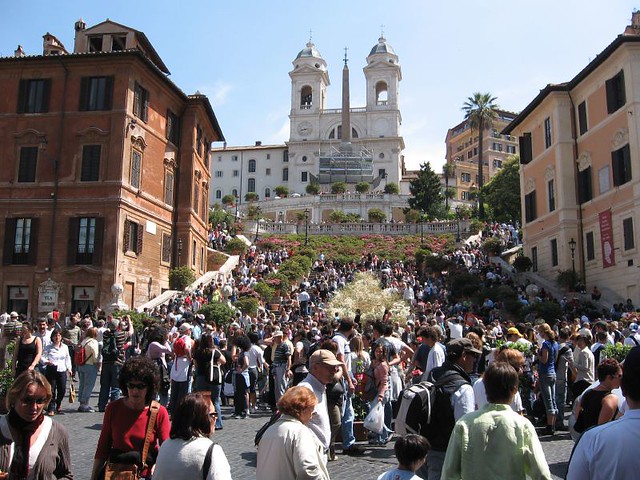 A truly monumental stairway of 135 steps, the Spanish Steps were built with French funds between 1721‑1725 in order to link the Bourbon Spanish embassy to the Holy See with the French church, Trinità dei Monti. The steps are usually very crowded attracting tourists as well as locals who use it as a gathering place. Each year in May the steps are decorated with pink azaleas. At the foot of the Spanish Steps is the Piazza di Spagna (Spanish square) and the Fontana della Barcaccia, a sober fountain designed by Gian Lorenzo Bernini.
 flickr/Mark Turner
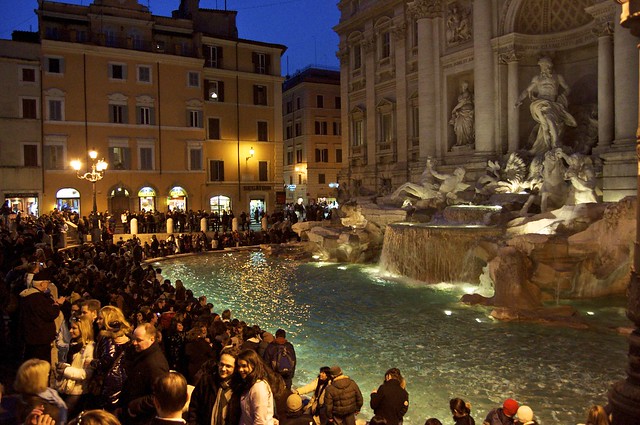
Completed in 1762 to a design by Nicola Salvi, this world famous Baroque fountain features a mythological sculptural composition of Neptune, god of the sea, flanked by two Tritons. The location of the Trevi fountain marks the terminus of the ancient Aqua Virgo aqueduct and is so named on account of its position at the junction of three roads (tre vie). The fountain was the setting for an iconic scene in Fellini’s film Dolce Vita starring Anita Ekberg and Marcello Mastroianni. Since than, it has become one of the most popular Rome tourist attractions. The legend says that one who throws a coin in the fountain shall one day return to Rome.
flickr/Mark Turner
Completed in 1762 to a design by Nicola Salvi, this world famous Baroque fountain features a mythological sculptural composition of Neptune, god of the sea, flanked by two Tritons. The location of the Trevi fountain marks the terminus of the ancient Aqua Virgo aqueduct and is so named on account of its position at the junction of three roads (tre vie). The fountain was the setting for an iconic scene in Fellini’s film Dolce Vita starring Anita Ekberg and Marcello Mastroianni. Since than, it has become one of the most popular Rome tourist attractions. The legend says that one who throws a coin in the fountain shall one day return to Rome.
 =
=
Founded by Pope Julius II in the 6th century, the Vatican Museums inside the Vatican City boasts some of the world’s most important relics. Attractions of the museums include the spiral staircase, the Raphael Rooms and the exquisitely decorated Sistine Chapel. Under the patronage of Pope Julius II, Michelangelo painted the chapel ceiling between 1508 and 1512. Today the ceiling, and especially The Last Judgment, are widely believed to be Michelangelo’s crowning achievements in painting.
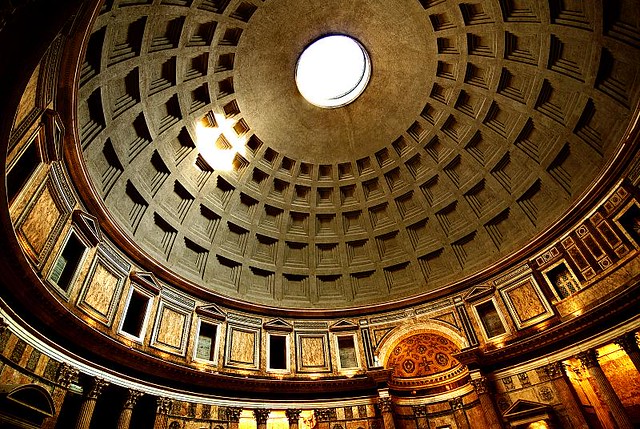
One of the best preserved Roman buildings, The Pantheon was built in 126 AD as a temple for all the Roman gods. The temple has served as a Roman Catholic Church since the 7th century. The Pantheon consists of a large circular portico with three ranks of huge granite Corinthian columns. The portico opens into a rotunda which is topped with a concrete dome with a central opening: the oculus. Almost two thousand years after it was built, the Pantheon’s dome is still the largest unreinforced concrete dome in the world.
 flickr/ewewlo
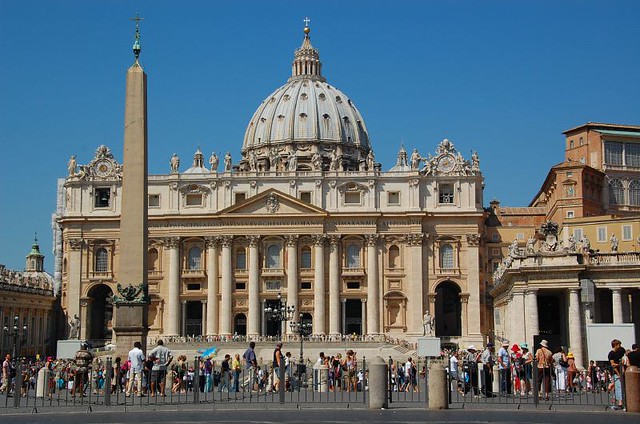
The center of the Catholic world and a major tourist attraction, the Basilica of St. Peter is a huge church: with an interior height of 120m, the space shuttle, together with its booster rockets, could fit inside, as could the Statue of Liberty. The basilica stands on the traditional site where Peter, the apostle who is considered the first pope, was crucified and buried. Construction on the current building began in 1506 and was completed in 1615. Many famous artists worked on the complex and its surroundings: Michelangelo designed the dome while Bernini designed the great St. Peter’s Square.
flickr/ewewlo
The center of the Catholic world and a major tourist attraction, the Basilica of St. Peter is a huge church: with an interior height of 120m, the space shuttle, together with its booster rockets, could fit inside, as could the Statue of Liberty. The basilica stands on the traditional site where Peter, the apostle who is considered the first pope, was crucified and buried. Construction on the current building began in 1506 and was completed in 1615. Many famous artists worked on the complex and its surroundings: Michelangelo designed the dome while Bernini designed the great St. Peter’s Square.
 flickr/Brunswickian
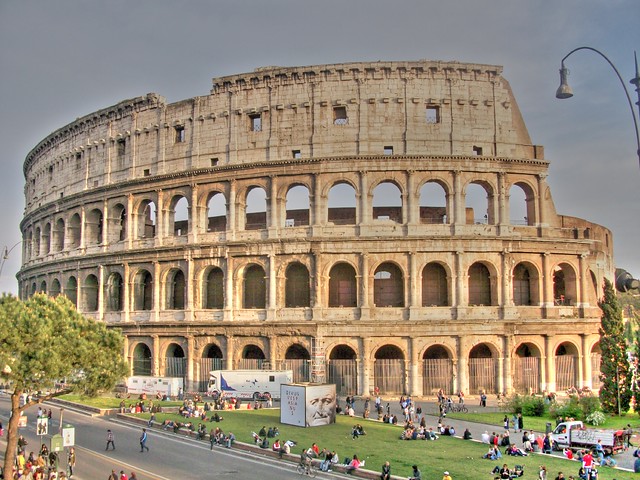
The Colosseum is the largest and most famous amphitheater in the Roman world. Its construction was started by emperor Vespasian of the Flavian dynasty in 72 AD and was finished by his son Titus in 80 AD. The Colosseum was capable of holding some 50,000 spectators who could enter the building through no less than 80 entrances. The Colosseum today is a major tourist attraction in Rome with thousands of tourists paying to view, what is left of, the interior arena.
flickr/Brunswickian
The Colosseum is the largest and most famous amphitheater in the Roman world. Its construction was started by emperor Vespasian of the Flavian dynasty in 72 AD and was finished by his son Titus in 80 AD. The Colosseum was capable of holding some 50,000 spectators who could enter the building through no less than 80 entrances. The Colosseum today is a major tourist attraction in Rome with thousands of tourists paying to view, what is left of, the interior arena.
7 Roman Forum
Located in the small valley between the Palatine and Capitoline Hills, The Roman Forum (or Forum Romanum in Latin) was for centuries the teeming heart of ancient Rome: the site of triumphal processions and elections, venue for public speeches, and nucleus of commercial affairs. The Forum today is a sprawling ruin of architectural fragments and includes the Arches of Septimius Severus and Titus, the Temple of Antoninus Pius and Faustina and the Temple of Saturn.
6 Spanish Steps
5 Trevi Fountain
flickr/Mark Turner
4 Vatican Museums
=Founded by Pope Julius II in the 6th century, the Vatican Museums inside the Vatican City boasts some of the world’s most important relics. Attractions of the museums include the spiral staircase, the Raphael Rooms and the exquisitely decorated Sistine Chapel. Under the patronage of Pope Julius II, Michelangelo painted the chapel ceiling between 1508 and 1512. Today the ceiling, and especially The Last Judgment, are widely believed to be Michelangelo’s crowning achievements in painting.
3. Pantheon
One of the best preserved Roman buildings, The Pantheon was built in 126 AD as a temple for all the Roman gods. The temple has served as a Roman Catholic Church since the 7th century. The Pantheon consists of a large circular portico with three ranks of huge granite Corinthian columns. The portico opens into a rotunda which is topped with a concrete dome with a central opening: the oculus. Almost two thousand years after it was built, the Pantheon’s dome is still the largest unreinforced concrete dome in the world.
2. St. Peter's Basilica
flickr/ewewlo
1. Colosseum
flickr/Brunswickian10 Top Tourist Attractions in Kenya
Famous for its classic savanna safaris, Kenya is a country of dramatic extremes and classic contrasts. Deserts and alpine snows; forests and open plains; the metropolis of Nairobi and colorful tribal cultures; freshwater lakes and coral reefs. For many people, Kenya is East Africa in microcosm. The wildlife safaris have been the top tourist attractions in Kenya for decades while other activities include trekking Mount Kenya, ballooning over the Masai Mara and snorkeling in Malindi on the Indian Ocean coast.
10. Nairobi National Park
 flickr/mosilager
Nairobi National Park is just a 10 minutes drive from the center of Nairobi with only a fence separating the park’s wildlife from the metropolis. Nairobi’s skyscrapers can be seen from the park. Despite its proximity to the city and the relative small size of the park, Nairobi National Park boasts a large and varied wildlife population. Migrating wildebeest and zebra gather in the park during the dry season, and it is one of Kenya’s most successful rhinoceros sanctuaries.
9. Malindi
 flickr/lauren_pressley
8. Mount Kenya
 flickr/John Spooner
7. Samburu National Reserve
 flickr/Mainbube
6. Hell's Gate National Park
 flickr/Alexandre Moreau Photography
5. Lamu Island
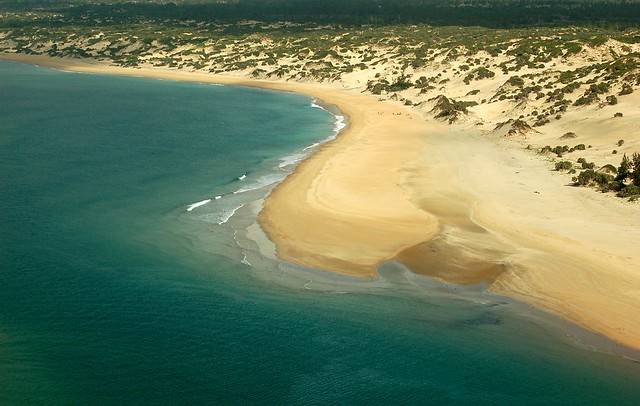 flickr/Cessna 206
4. Tsavo National Park
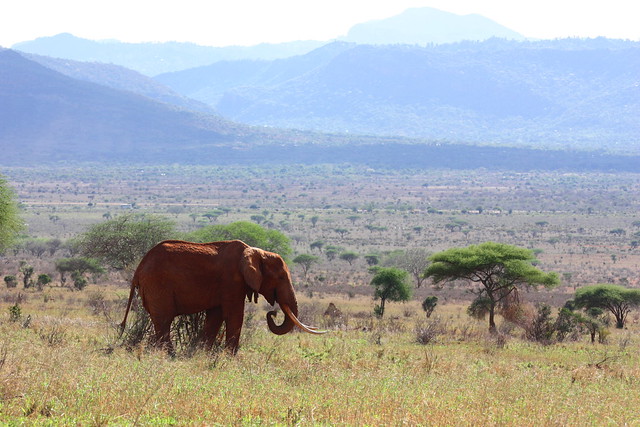 flickr/alles-schlumpf
3. Lake Nakuru
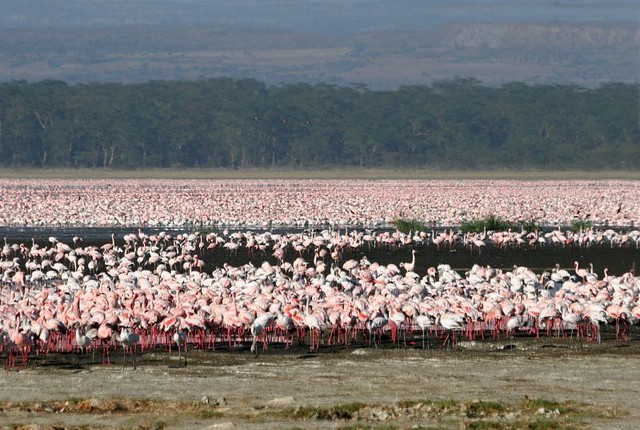 flickr/Picture Taker 2
2. Amboseli National Park
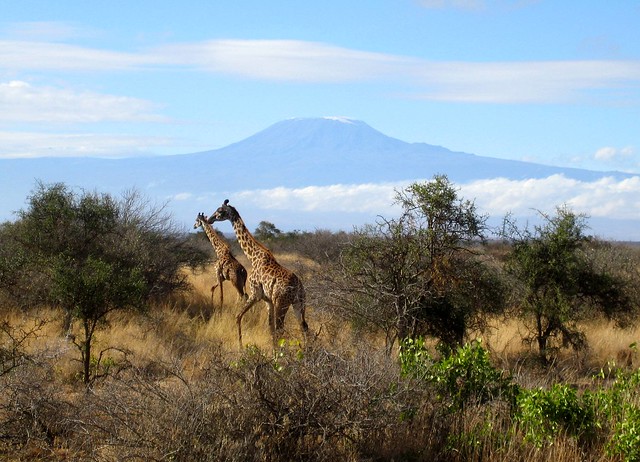 flickr/Jim Gleeson
1. Masai Mara National Reserve
 flickr/daretothink
The Masai Mara National Reserve is one of the top tourist attractions in Kenya and the country’s most popular game park. Each year the Masai Mara National Reserve is visited by thousands of tourists who come here to watch the exceptional population of game and the annual migration of zebra and wildebeest. The “Great Migration” takes place every year from July to October when millions of wildebeest and zebra migrate from the Serengeti in Tanzania.
More Kenya tourist attractions can be found in the Explore Kenya page.Monday, March 25, 2013

Travel around the world free of charge
A family or house from the locals or foreigners who live in your destination city
can host you free of charge.
CouchSurfing is an international non-profit network that connects travelers with locals in over 230 countries and territories around the world. Since 2004, members have been using the CouchSurfing system to come together for cultural exchange, friendship, and learning experiences. Today, anyone is able to share hospitality and cultural understanding.
can host you free of charge.
CouchSurfing is an international non-profit network that connects travelers with locals in over 230 countries and territories around the world. Since 2004, members have been using the CouchSurfing system to come together for cultural exchange, friendship, and learning experiences. Today, anyone is able to share hospitality and cultural understanding.
Cheap Hotels in Istanbul
Soho Hostel Istanbul
located near Taksim Square.
Basic 9 Bed Mixed Dorm: 6 Euro - 10.22 USD - 56 EGP
Book Now (Click Here)
located near Taksim Square.
Basic 9 Bed Mixed Dorm: 6 Euro - 10.22 USD - 56 EGP
Book Now (Click Here)


Cheapest Flight to Istanbul
You will never imagine that the cheapest flight to Istanbul is on "Turkish Airlines".
they have special dates for those cheap flights, for example:
From Cairo International Airport (CAI) to Istanbul Ataturk Airport (IST):
costs only: 156 EURO - 203 USD - 1360 EGP
to check all prices from other cities to istanbul:
https://turkishairlines.com/
note: search for lower fares through trying many dates

From Cairo International Airport (CAI) to Istanbul Ataturk Airport (IST):
costs only: 156 EURO - 203 USD - 1360 EGP
to check all prices from other cities to istanbul:
https://turkishairlines.com/
note: search for lower fares through trying many dates
Sunday, March 24, 2013

Subscribe to:
Comments (Atom)